Solange in Carson
Some words on my hometown and its history

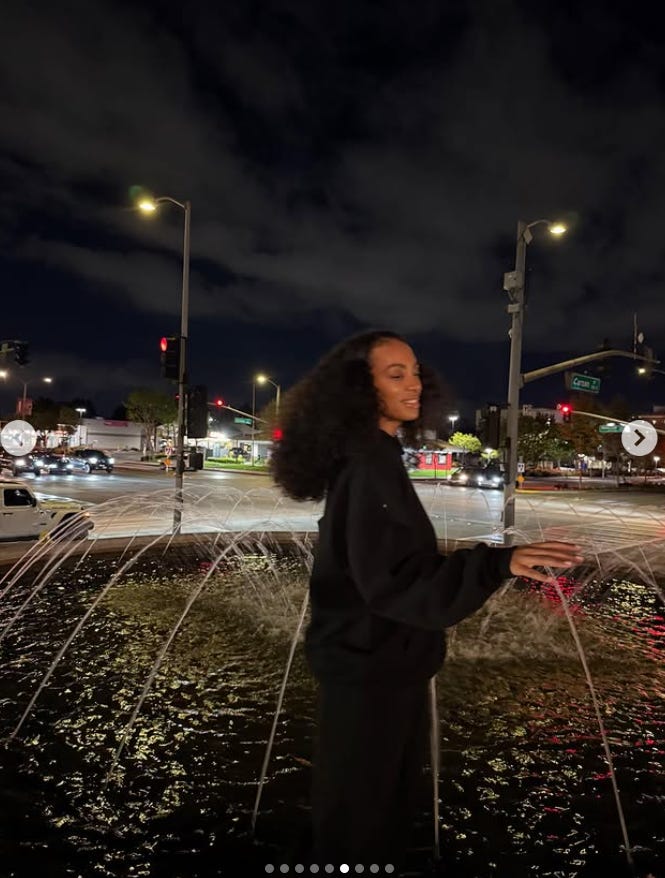
Solange Knowles recently posted some photos of herself frolicking at night in water fountains around the world. One of these was the fountain outside Carson’s City Hall, a suburb in the South Bay of Los Angeles. Carson is my hometown, so over the next day or so my feed was accordingly spammed with reposts from old classmates and cousins. The spot is at a drab intersection between an IHOP and Carl’s, Jr., adding to the amusement. What business does she have here?
True to form, this output from Solange, however small, stirred me...the caption reads “⛲️ May I Flow Forever ⛲️”… I knew there was something to make of it. Take this: Solange has a synergetic artistic partnership with Steve Lacy, who grew up in the area and frequents it. In a recent piece from Dazed, Solange talks about spending much time with Lacy’s family.
Indeed, Steve Lacy is perhaps the best ambassador for Carson. He is Black and Filipino— the city is also known for its Filipino-American population— and, like most notable people from Carson, transient as hell. Steve technically grew up in adjacent Compton, but briefly attended Narbonne High School in Harbor City. His mother taught for some time at California State University, Dominguez Hills in Carson. The school is colloquially known as an HBCU. In the early 2010s, the heyday of Odd Future, Steve and other collective members were often spotted by locals hanging out in these inland cities of the South Bay. Obviously Compton, but also Carson, Gardena, Lawndale, and Hawthorne.1 The entire subregion is bizarrely organized in a way illegible to outsiders, with many pockets of unincorporated neighborhoods and undeveloped land. As such, folks often shuttle around from different neighborhoods to access better schools, hospitals, social scenes.
Of course, as Steve’s immigrant heritage might allude, these qualities are what attract newcomers. As the industrial backyard of LA County, with warehouses, refineries and the port, cheap and dirty work has long been readily available.2 In Chester Himes’ 1945 novel If He Hollers, Let Him Go, a founding story of Black LA, protagonist Robert “Bob” Jones comes from Ohio to work in a naval shipyard in the South Bay. In his free time, he hangs around San Pedro and Compton. Like many, Bob partook in the Great Migration(s), seeking an upward mobility rural America could not provide. Much of this history’s successes were early pummeled. Take Manhattan Beach, a haven for Black beachgoers co-opted in 1929 through eminent domain. Later, people regard this history by its failures.
Carson was incorporated in 1968, adopting the motto “Future Unlimited.” The city’s website: “Its strategic location and vacant land were part of the reason for that statement of unbridled optimism.” Its two anchor institutions, City Hall and Cal State Dominguez Hills, were fashioned in part to serve the emergent Black American population. Carson City Hall, where Solange stood, was designed in the 1970s by Robert Kennard, of the second generation of Black modernist architects. Cal State Dominguez Hills was founded in the 1960s as direct resource for Black American youth following the Watts Rebellion, and it continues to be a Black-Serving Institution.3 Both, in part, forged the city’s reputation as a middling urban suburb, shadowed by the mythologies of Compton on one end and the beach cities on another. But it keeps trudging along: compared to Compton, the Black population in Carson is holding steady.4 As of 2000, it was the only incorporated city in the United States where the Black median income is higher than the white one.
It is not for me to say if Carson is an overlooked success of any sort. I am just fascinated by its quiet presence, and the way people move through it. Of the storied list of Carson folks— Brandy, Dr. Dre, Forest Whittaker— none have spent more than a few years here.
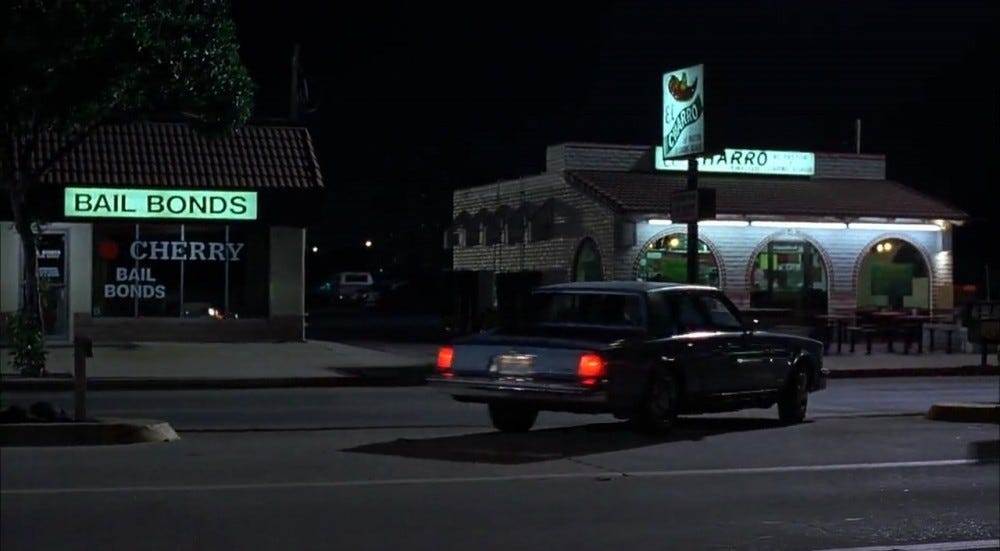
Quentin Tarantino, another South Bay alum, portrays this mundane transience pretty aptly in Jackie Brown. (Tarantino, like Lacy, also briefly attended Narbonne High School.) Like many of his films, Jackie Brown riffs on the Blaxploitation genre and heavily deploys racist tropes. Pam Grier, known for playing Foxy Brown, stars as a flight attendant for a minor airline tasked with smuggling gun money to and from Mexico. Samuel L. Jackson plays the maniacal gun runner. Most of the crazier notes of the film are lost on me. It’s the portrayal of the South Bay that is poignant: the way a location appears with seemingly no connection to the other, Grier running through LAX and the Del Amo mall. At the end of the film, Grier, having double-conned the cops and Jackson, must choose between leaving town forever or staying with her love interest, a white guy named Max Cherry. There, in the middle of Cherry Bail Bonds in Carson, she chooses to leave. That bail bonds spot is now IHOP. And across the street, Solange’s fountain.
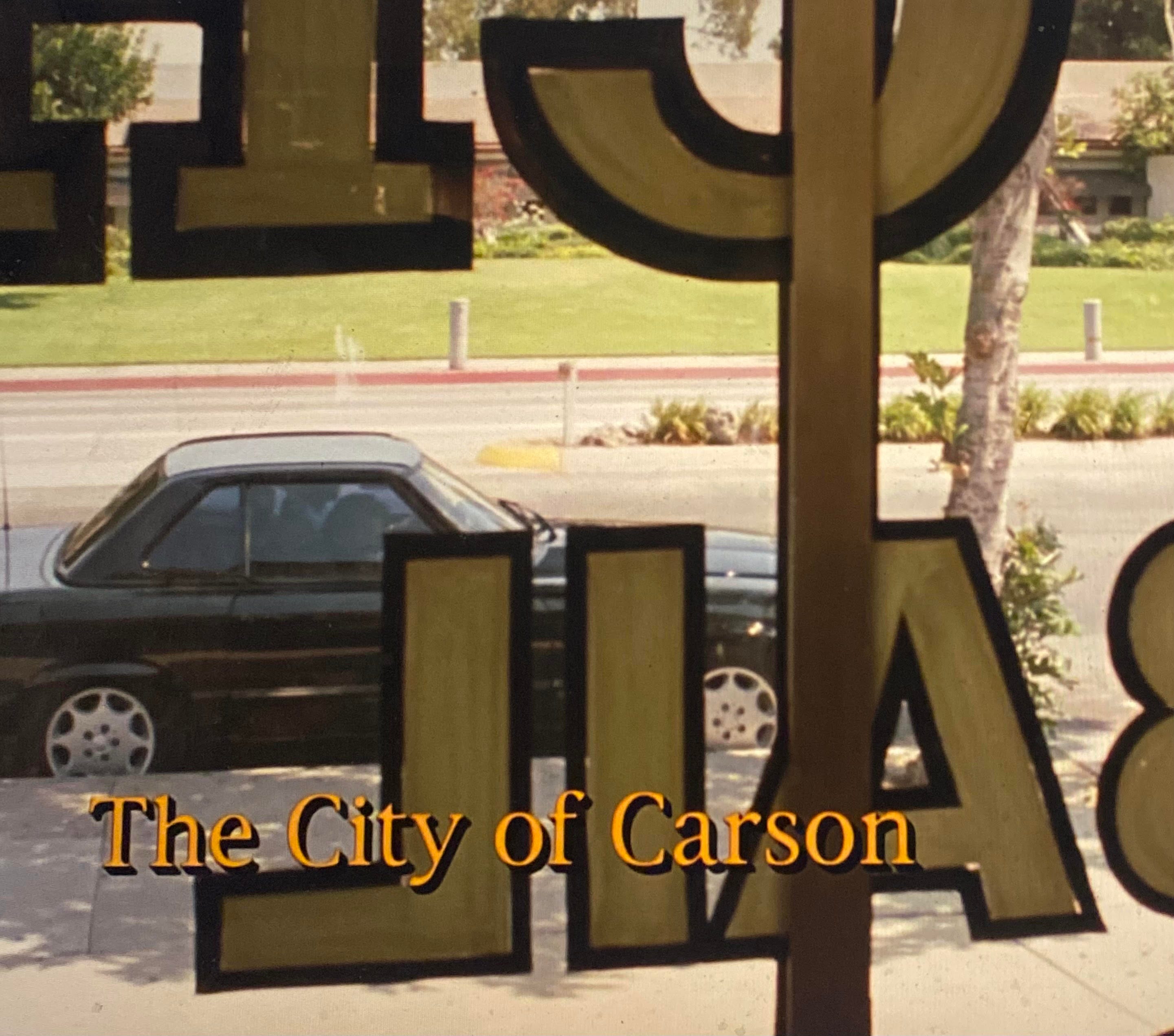
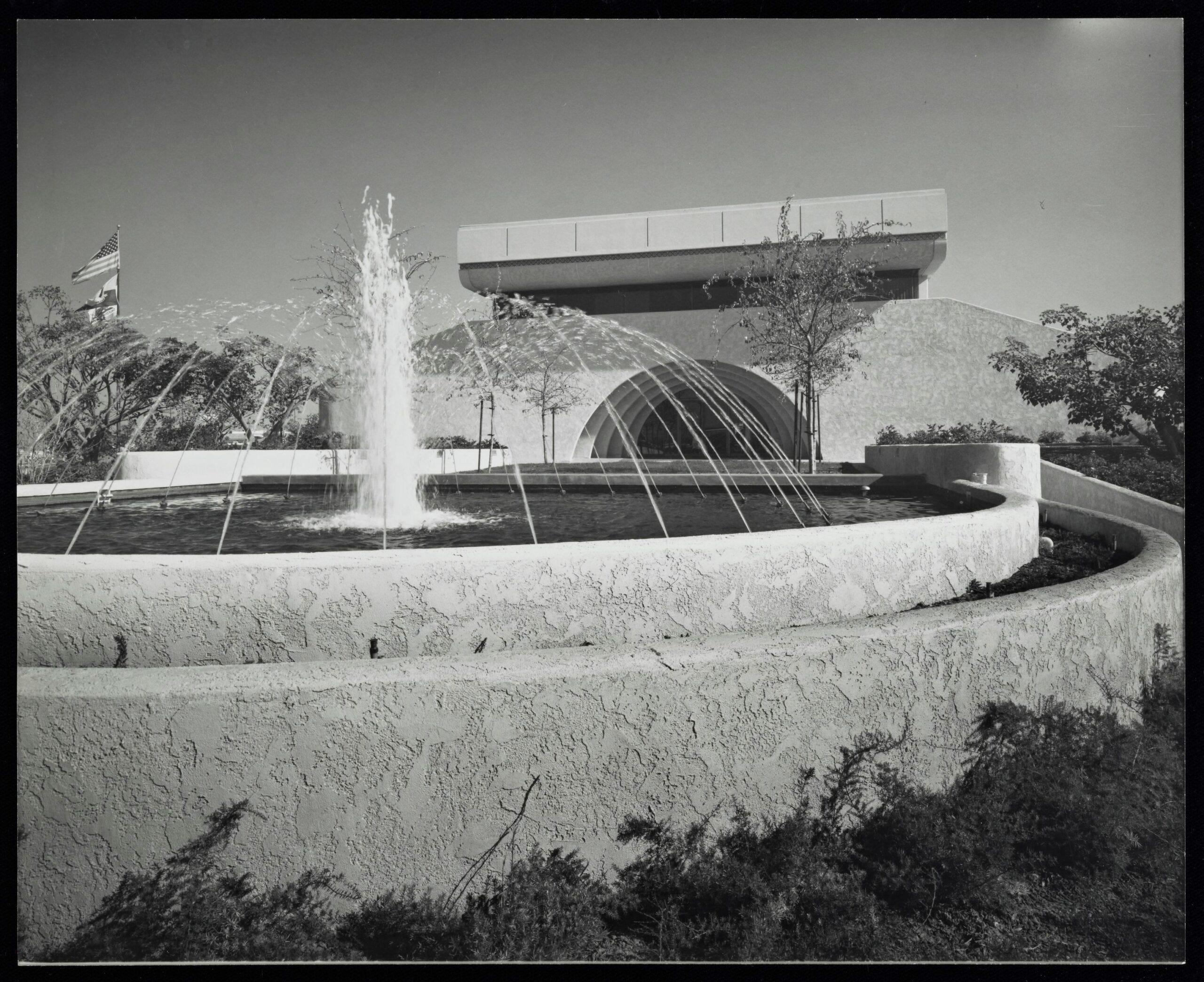
In 2023, Carson City Hall received a Conserving Black Modernism Grant from the National Trust for Historic Preservation. Here’s to flowing forever~~
— Steph
Tyler, the Creator is from Hawthorne.
For more on the contemporary impact of these industries, see the work of journalist (and my old classmate) Adam Mahoney.
The term “Black-Serving Institution,” similar to “Hispanic-Serving Institution,” has been recently formalized in California.
Tangential, but I wanted to note that I attempted to disaggregate the data on Carson to make sure the claim was legitimate, following the idea introduced by Southeast Asian-Americans that disaggregation better accounts for the vast array of socioeconomic backgrounds within a single racial group.